Tell us about the job
Takes about a minute. No obligation.

Sizing a boiler for a Clay County home requires a contractor to work out exactly what the burner and heat exchanger will carry across a long heating season, because undersizing here does not stay hidden for long. Homes in Clay County, NE run heat about eight months a year, from October through May. The burner cycles through that demand repeatedly, and a unit that cannot meet the load runs longer and harder each time, wearing the ignition system and heat exchanger at an accelerated rate. A contractor who skips the load calculation and installs by rough estimate leaves the homeowner with equipment that will show the mistake in the components that cycle most.
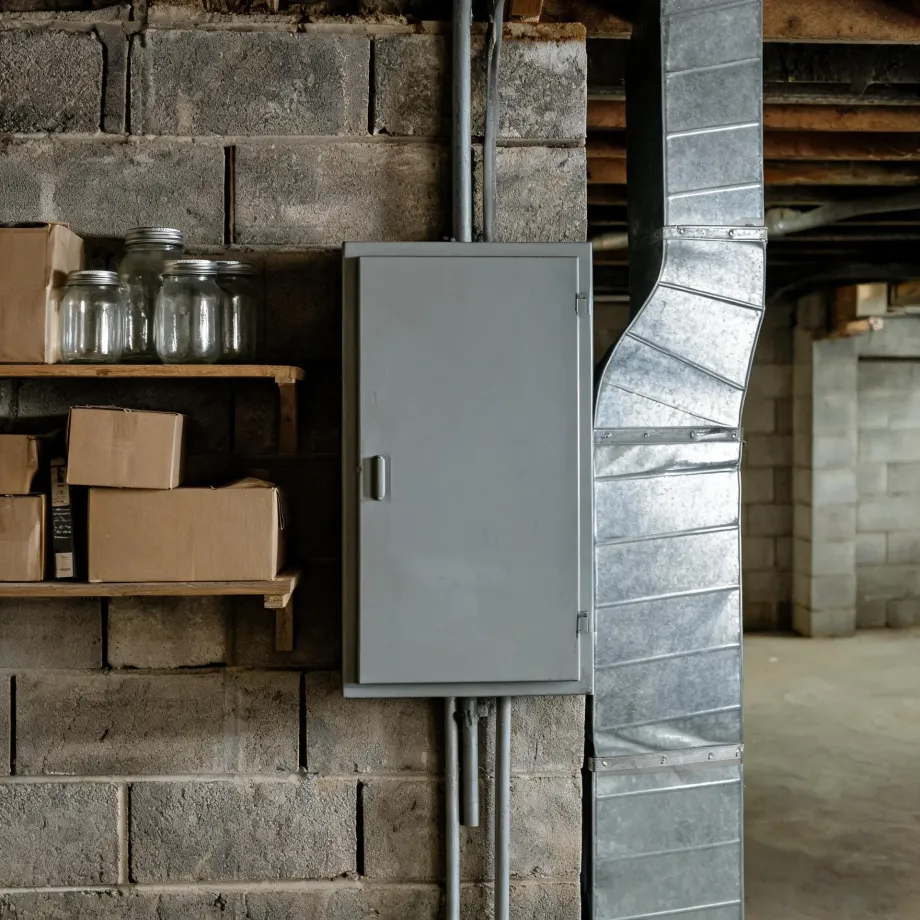
Ductwork laid down for an earlier generation of heating often runs at dimensions and configurations a modern boiler installation has to work around. Half the homes in Clay County, Nebraska were built in 1954 or earlier (2020-2024 ACS 5-year). That depth of stock means a contractor quoting a boiler here opens questions about the distribution side before settling anything about the unit itself: whether the existing runs can carry the output, where the bottlenecks are, and what has to be modified. The electrical picture follows the same logic. A house where the heating infrastructure was put in long before the current equipment was designed may need both addressed before the boiler goes in.
What Gets Installed With a New Boiler
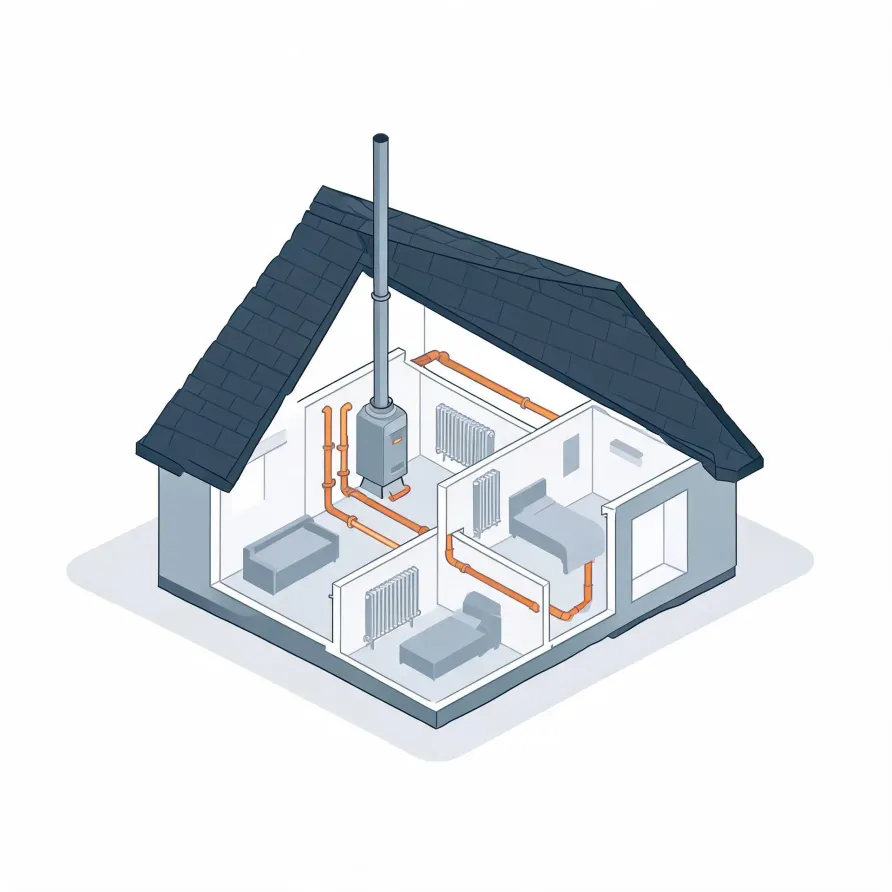
The boiler itself sits in the basement or mechanical room and is the unit that heats water for the whole system. Near it, an expansion tank absorbs pressure changes as the water heats and cools. A circulator pump moves that heated water out through the pipes.
Radiators or baseboard convectors run through the living spaces and are the points where heat actually enters the rooms. Supply and return piping connects the boiler to each of those terminal units, and a thermostat mounted on a wall gives the homeowner control over when the system runs.
The drawing shows the general layout of a boiler system, and a licensed contractor determines what applies to this particular house.
Find a contractor in Clay CountyClay County, Nebraska, by the numbers
252 severe weather events were recorded in Clay County, Nebraska between 2015 and 2024.
NOAA National Centers for Environmental Information, Storm Events Database, bulk CSV export, events 2015-01-01 through 2024-12-31.Half the homes in Clay County, Nebraska were built in 1954 or earlier (2020-2024 ACS 5-year).
U.S. Census Bureau, 2020-2024 American Community Survey 5-Year EstimatesClay County, Nebraska holds 2,817 housing units (2020-2024 ACS 5-year).
U.S. Census Bureau, 2020-2024 American Community Survey 5-Year EstimatesOwners occupy 81.9% of the occupied homes in Clay County, Nebraska (2020-2024 ACS 5-year).
U.S. Census Bureau, 2020-2024 American Community Survey 5-Year EstimatesBoiler Installation Rules for Clay County, Nebraska1 sourced standards and codes
Licensing and Legal Requirements in Clay County, Nebraska
Nebraska requires registration rather than a licence: a contractor must be registered with the Department of Labor before performing any construction work, though anyone earning less than five thousand dollars a year from construction services is not a contractor under the Act at all.
Severe Weather Events in Clay County
Weather patterns in this part of Nebraska put real demand on heating equipment. A boiler sized and installed without accounting for local conditions is working against the climate it lives in.
252 severe weather events, 2015–2024. Source: NOAA National Centers for Environmental Information, Storm Events Database.