Tell us about the job
Takes about a minute. No obligation.
A boiler running through a long heating season puts its burner, heat exchanger, and ignition system through repeated cycling with almost no rest between seasons. Homes in Webster County, NE run heat about eight months a year, from October through May. Contractors diagnosing repairs here find components that have been under sustained thermal stress, and the parts that fail first are the ones that cycle on every call for heat: igniters, heat exchanger sections, and circulator pumps. A unit that starts each season with a marginal igniter or a hairline crack in the exchanger will not make it through without showing the problem. That is what a contractor has to establish before the repair scope makes sense.
Boilers in houses this old carry a history in their components that a contractor reads by opening the system. Half the homes in Webster County, Nebraska were built in 1951 or earlier (2020-2024 ACS 5-year). That means the cast iron sections, the expansion tanks, the zone valves, and the controls a contractor finds when a boiler goes down here have been running, cycling, and corroding since before most of the current equipment lines existed. Whether a part is still manufactured in the form that system takes is something a contractor determines from what is in front of them, and that answer shapes the repair scope more directly than any other variable on the job.
The Parts of a Boiler a Contractor Checks First
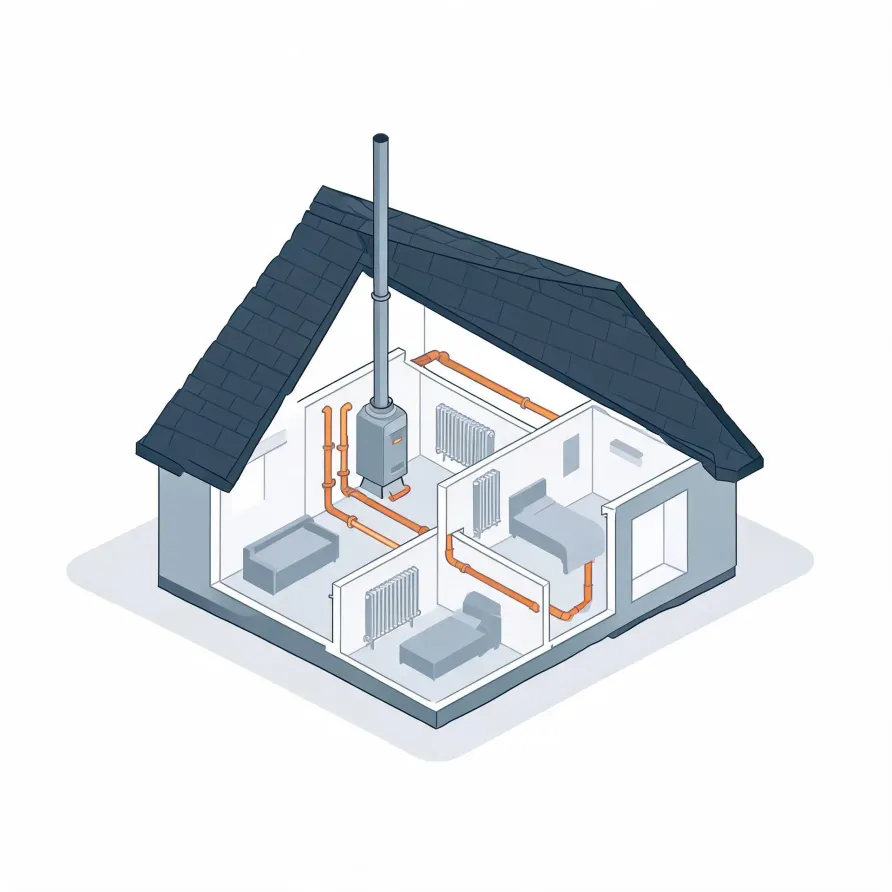
The boiler itself sits in the basement or a utility room and is the piece a contractor goes to first. It heats water and pushes it through the system. When heat stops reaching a room or the unit short-cycles, the burner assembly, heat exchanger, or pressure vessel is often where the fault lives.
Circulator pumps move the heated water through the pipes to each radiator or baseboard unit in the living spaces. The expansion tank, usually mounted near the boiler, absorbs pressure shifts as water heats and cools. The thermostat and zone valves tell the system when to run and where to send heat, so a wiring fault or stuck valve can mimic a boiler problem.
The drawing shows a typical boiler layout, and a licensed contractor determines which components and conditions apply to your specific home.
Find a contractor in Webster CountyWebster County by the numbers
142 severe weather events were recorded in Webster County, Nebraska between 2015 and 2024.
NOAA National Centers for Environmental Information, Storm Events Database, bulk CSV export, events 2015-01-01 through 2024-12-31.Half the homes in Webster County, Nebraska were built in 1951 or earlier (2020-2024 ACS 5-year).
U.S. Census Bureau, 2020-2024 American Community Survey 5-Year EstimatesWebster County, Nebraska holds 1,764 housing units (2020-2024 ACS 5-year).
U.S. Census Bureau, 2020-2024 American Community Survey 5-Year EstimatesOwners occupy 80.6% of the occupied homes in Webster County, Nebraska (2020-2024 ACS 5-year).
U.S. Census Bureau, 2020-2024 American Community Survey 5-Year EstimatesCodes & Standards Governing Boiler and HVAC Repair in Webster County, Nebraska1 sourced rules and standards
Licensing Rules for HVAC Repair in Webster County, Nebraska
Nebraska requires registration rather than a licence: a contractor must be registered with the Department of Labor before performing any construction work, though anyone earning less than five thousand dollars a year from construction services is not a contractor under the Act at all.
Severe Weather Events in Webster County
Extreme weather puts real stress on heating equipment, and boilers in Webster County work in whatever conditions the climate delivers. Repair frequency, component wear, and system load are all shaped by local conditions.
142 severe weather events, 2015–2024. Source: NOAA National Centers for Environmental Information, Storm Events Database.